
Korean New Year s the first day of the Korean lunar calendar. It is one of the most important traditional Korean holidays.The celebration usually lasts three days: the day before Korean New Year, Korean New Year itself, and the day after Korean New Year. During this time, many Koreans visit family, perform ancetral rites, wear hanbok, eat traditional food, and play folk games.Additionally, children often receive money from their elders after performing a formal bow.
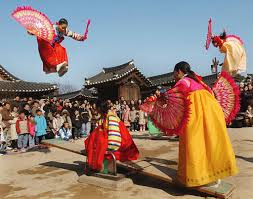
Korean New Year generally occurs in January or February on the second new moon after the winter solstice, unless there is a intercalary eleventh or twelfth month in the lead-up to the New Year. In such a case, the New Year falls on the third new moon after the solstice. Korean New Year typically falls on the same day as Chinese New Year.
Korean New Year is typically a family holiday.The three-day holiday is used by many to return to their hometowns to visit their parents and other relatives, where they perform an ancestral ritual called charve. The three days are the day of, the day before, and the after. any preparations go into celebrating the Korean New Year. During the first morning, Koreans pay their respect towards their ancestors. Traditional foods are placed on a table as an offering to the ancestors, and a rite begins with deep bows from all family members. This is a sign of respect and a very important practice on the first day of the New Year in Korea. It is also where they pray for the well-being of all the family membersMany Koreans dress up in colorful traditional Korean clothing called hanbok. Hanbok are usually worn for special occasions such as weddings, Korean New Year, child’s first birthday, etc. however, with modernization and evolving mores in the culture, more people tend to prefer westernized, modern clothing to the hanbok. After the rite, the members have a big feast.Additionally, Koreans follow a zodiac similar to the Chinese zodiac. Twelve animals represent the 12 years in sequential order with the rat/mouse representing the first year. Buddha is believed to have invited animals from all over the world to visit, to which only 12 visited. In return, he honored them by naming the years in the order that they arrived. Koreans believe that specific zodiac animals bring specific resources and qualities. For example, the year 2014 was the year of the horse, and it was considered a good year in the money and career aspect of life. It is said that a person born in a specific zodiacal year will carry that zodiac animal’s characteristics. As a result, Koreans plan their year and activities around it to have a good, prosperous year. Parents may have even planned the birth year of their child, so the child may have a specific characteristic. It is fair to say that the Korean zodiac is an important part of Korea’s culture.Another custom observed is the lighting of a “moon house” built from burnable firewood and branches. This symbolizes the warding off of bad/evil spirits for the new year. Many also choose to add wishes they want come true in the next year to the moon house.
 Աննա Խաչատրյան